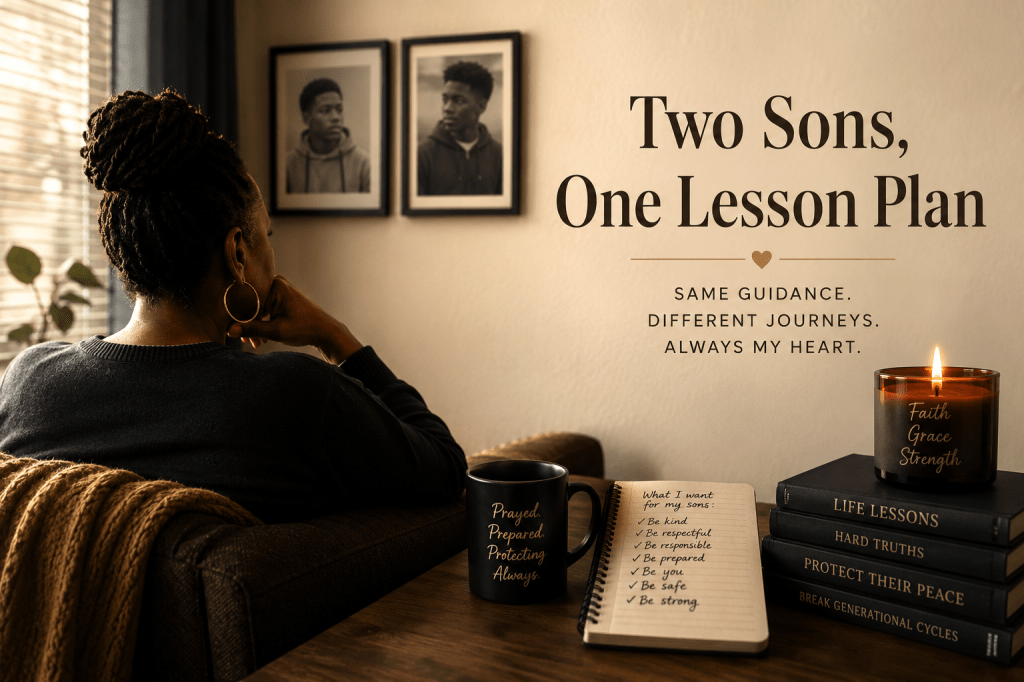
Motherhood has taught me that raising children is not the same as controlling what they will remember about being raised.
I have two sons, and from the time they were old enough to understand me, I tried to prepare them for life using everything life had taught me. I did not hide my struggles or pretend I had always made the right decisions. I talked to them about the jobs that did not work out, the people I trusted who did not deserve it, the choices that cost me, and the lessons I learned much later than I wish I had.
My life became part of the lesson plan.
I wanted them to know what to watch for in people, workplaces, relationships, and situations that looked harmless in the beginning but could become costly later. I wanted them to understand that words and intentions are not always enough. Actions matter. Patterns matter. Character matters. Knowing when to stay, when to speak, and when to walk away matters.
Two sons. One lesson plan.
Teach them from my mistakes so they would not have to repeat them.
Teach them what the world was like so the world would not swallow them whole.
Teach two young Black boys how to become respected and respectful Black men in a world that might judge them more harshly, forgive them less easily, and misunderstand them before giving them a chance to explain themselves.
That responsibility made me tough.
There were times when I pushed harder than they understood. I corrected what may have seemed small because I knew small things could carry larger consequences outside the safety of home. I expected them to think ahead, take responsibility, and understand how their choices might be perceived by people who did not know their hearts.
At the time, I believed preparation was one of the greatest forms of protection I could offer.
What I did not understand was that the same lesson could be received in completely different ways.
One child may hear a warning and recognize the experience behind it. He may not follow every piece of advice, but he understands that the person giving it has already traveled far enough down the road to recognize the danger ahead.
Another child may need to travel the road himself.
You can tell him that the street ends ahead, but he may still need to drive far enough to see the dead end with his own eyes. The warning does not become real until he experiences the turn, the frustration, and the realization that there is nowhere else to go.
That does not mean he was not taught.
It means experience became the teacher he understood best.
Motherhood becomes complicated when the guidance you remember giving does not match the childhood your adult child remembers receiving. A mother can recall the conversations, the warnings, the sacrifices, and the countless attempts to prepare her child, while that same child remembers feeling as though he had to figure life out for himself.
Both memories can exist in the same family.
That is difficult for me to accept.
There is a part of me that wants to defend my motherhood and account for every lesson. I want to say that I was there, that I talked, that I warned, that I tried. I want my sons to understand that what sometimes felt like hardness was often fear. I knew I could not protect them from the world forever, so I tried to make them strong enough to survive it.
Still, good intentions do not determine how our children experience us.
The toughness I viewed as preparation may have sometimes felt like pressure. My desire to keep them from repeating my mistakes may have sounded as though I did not trust them to make their own decisions. The lessons I believed I was giving in love may not always have felt loving in the moment.
That is one of the uncomfortable truths of motherhood. We can love our children deeply, give them everything we know, and still discover that some parts of our love did not reach them in the way we intended.
I can acknowledge that without erasing myself.
I was not a perfect mother. I did not always choose the right words, and I may not have recognized how differently each of my sons needed to be guided. I was raising them while still learning myself, trying to turn my own losses into something useful before my children had to suffer the same ones.
Some lessons can be passed down through conversation. Others refuse to become wisdom until life makes them personal.
Perhaps that is where the difference lies.
One son may see my toughness and recognize the protection beneath it. The other may remember the weight of the toughness more clearly than the reason behind it. Neither response changes the love that motivated me, but both responses teach me something about the limits of intention.
Two sons received the same lesson plan, but they were never the same student.
They heard differently.
They learned differently.
They carried my words differently.
And now, as their mother, I am learning that raising children sometimes means accepting that the story they tell about their lives may not sound like the story I remember living beside them.
I do not have to argue with their memories to honor my own.
I know what I tried to give them.
I also know that motherhood is not measured only by what we teach, but by whether we remain willing to listen when our children tell us how those lessons felt.




Leave a comment